Limited Offer
Feel Like Your Content’s
Invisible Online?
1-on-1 coaching. Personalized Content Strategies & Viral Techniques & Templates designed for today’s algorithm.
Join 2,000+ content creators proving it’s never too late to breakthrough online.

Some people think getting paid for brand collabs on Instagram goes like this:
- Create an Instagram account
- Post whatever you want
- People will start following you (somehow)
- Once you reach a certain number of followers (say, 10k followers), brands will suddenly start approaching you.
In reality, that rarely ever works.
If you want to get collabs, you need to be intentional about it.
Every successful creator gets their collabs not by luck or chance, but by creating an account that’s great for both followers AND brands alike.
How do you do this?
In this article, I’ll go over the 6 steps for success, so that you can get your first brand collab, get paid for it, and eventually turn your account into a thriving online business.
How to Get Collabs on Instagram
Step #1: Create an Account With Brands in Mind (Mindset Shift)
Most people who start an Instagram account think about what they want to post. Others think about what type of content will get followers.
But if you want brand collabs, you need to take it a step further.
Ask yourself:
“What type of content will make brands want to work with me?”
Start thinking like a brand, and ask:
- What kind of creator represents our ideal customer?
- Who can communicate our message well?
- Who already posts about topics related to our product category?
- Who has a style, tone, or personality that aligns with us?
You don’t have to do anything about it yet (we’re still on step 1!).
But this mindset shift puts you on the right track, and everything from here will make so much more sense.
Once you’re in, then proceed to the next step……
Step #2: Research Your Dream Brand
Start by making a list of 20-30 brands you’d love to work with.
Not just random brands, of course. Find brands that:
- Fit your planned niche
- Have products you’ll genuinely use
- Your target audience cares about (or should care about if it’s not a popular brand)
Make your list a mix of small, unknown brands, medium-sized brands, and even BIG brands (these are harder to reach, but you never know what can happen).
Once you have this list, research:
- Who their customers are
Their customers’ age, location, lifestyle, and hobbies.
The good news is that this is easy to figure out. Just take a look at how the brand advertises itself. If you pay attention to the type of people they feature in their ads, you’ll see who their target customer base is.
You can also head to the brand’s social media and take a peek at who follows them. Scroll through 50 or so followers, and you should see a pattern of what type of people follow the brand.
- What problems the brand is trying to solve when people buy the product
Again, study the brand’s advertising.
What pain points do they highlight for their target customers? How do they position their product as a solution to those pain points?
Also, check the brand’s reviews. Take note of what people love about the product, and pay attention to the negative reviews as well (this will tell you which promises were not delivered).
- The brand’s tone and personality (
Go to the brand’s social media pages and see what type of personality they use. Is it fun, serious, premium, minimalist, adventurous, or something else?
This is important because if the brands in your niche are more serious and “premium,” you might struggle to get a deal if your account is more playful.
- Which creators they currently work with
Finding creators that the brand already works with tells you that they’re open to brand collabs, and it also shows you what type of creators they work with.
Some ways to find the creators brands work with include checking the brand’s tagged photos in IG, searching the brand name in search, looking up hashtags like #brandname, or reverse searching by looking at a creator in your niche and checking who sponsors them.
You can use this information to build your Instagram account.
Make your niche target the brand’s ideal customer profile.
Talk about the pain points that the brand is trying to solve with its product.
Match the brand’s tone and personality.
And get content ideas from creators they already work with.
So many new creators skip this step when starting their account (and then wonder why getting brand collabs is “so hard”).
Some people get brand collabs without ever thinking about this step.
But the truth is, this small step before creating an account makes a HUGE difference in how easy scoring deals will be later on.
Step #3: Build Your Personal Brand
The next step is to build your personal account.
Your target audience is the same as the brand, but your tone should be uniquely you.
This is because people love following individuals.
If they sense that you’re a parrot for a brand, you’ll struggle getting loyal followers.
In the same note, brands love working with individuals, too.
They’re looking for individuals who their target customers look up to. That way, if you vouch for their brand, the people who look up to you will buy the product.
So… how do you build your account?
Here are some quick tips to get you up and running:
- Find Viral Ideas and Tweak Them — search for what’s going viral in your niche, copy the idea, but add your own unique twist!
- Post Every Day — without sacrificing quality. This not only gets you followers faster, but it also teaches you what works and what doesn’t in your niche very quickly.
- Use Keywords — use keywords related to your niche in your descriptions. Hashtags aren’t effective anymore, but Instagram categorizes your account by looking for keywords in your niche.
- Make an Original Series — an original series gives you unlimited content to post, and makes you noticeable to people in your niche.
- Answer Every Comment — interact with your community as much as possible. This helps build a loyal follower base.
- Show Your Face — while this is optional, showing your face brings so much authenticity to your account. This will be a huge help not only in getting followers but also scoring brand deals later on.
I go more in-depth into these in my How to Get More Followers post. So go check that out next.
But there’s one specific type of post you need to post if you want to work with brands — which brings us to our next step…
Step #4: Post Mutually Beneficial Reels
Don’t just post content that you or even your followers enjoy.
Mix in content that’s mutually beneficial for you AND the brands you want to work with too (even if you don’t have any deals yet).
If you have several posts that make your account “brand-ready,” it’ll be much easier to land a good deal. So here are some ideas you can try…
Lifestyle POVs
If your lifestyle matches that of the brand’s customers, then showcase your POV on things.
People will relate to you, and whatever problems you come across, so they’ll give you a follow.
And when brands see that you have an audience of their target customers, they’ll gladly pay you to promote their products.
Examples:
- “POV: Slow morning before work — coffee, skincare, and tidying.”
- “POV: Resetting my home after a long week.”
- “POV: Simple, peaceful Sunday routine.”
- “POV: Working from home while keeping life together.”
- “POV: Evening wind-down routine for stressed women.”
Problem-Solution
A variation of the lifestyle POV video where you talk about a common problem and how you fixed it.
This is great, especially if the problem is something the brand’s product can fix.
When you post reels like this, you can use your engagement numbers as leverage to strike a deal with a brand. Show them the numbers and say something like, “I could insert your product as the solution to all these people.”
Examples:
- “Struggling with clutter? Here’s how I reset my space in 10 minutes.”
- “If you’re always tired after work, try this simple routine.”
- “How I finally got consistent with skincare.”
- “What I do when I feel overwhelmed by my to-do list.”
- “The hack that helped me stop wasting money on groceries.”
Educational Tips
Educational tips establish you as an authority in the niche.
If your tips are super helpful and effective, people will naturally start looking to you whenever they run into problems.
This is a very strong position to have when working with brands because brands want someone their target customers already trust.
Examples:
- “3 skincare mistakes women in their 30s still make.”
- “How to build outfits with basic pieces you already own.”
- “Easy home habits that reduce stress.”
- “How to meal prep when you’re busy (but hate meal prep).”
- “Ways to make your home feel calmer instantly.”
Opinion Content
Post opinion pieces that align with the brand’s values.
For more “premium” brands, talk about why quality matters more than quantity. For more budget brands, talk more about value.
Examples:
- “Why your 30s are the best time to reinvent yourself.”
- “Why quality basics beat trendy fast fashion.”
- “Why ‘doing less’ is actually more productive.”
- “Why taking care of your home is self-care.”
- “Why skincare matters more than makeup as you get older.”
Before/After Transformations
This works particularly well in the beauty industry, where you show before/after makeup, hair, etc. But it can also work great in any niche.
Show what things were like before, what you did, and the amazing results afterward.
If you master this format, it becomes very easy to make the brand’s product the thing that caused the transformation.
Examples:
- “Before/after organizing my bathroom counter.”
- “Before/after my weekly fridge reset.”
- “Before/after cleaning my makeup drawer.”
- “Before/after switching from full glam to minimalist makeup.”
- “Before/after decluttering one small corner of my house.”
Product Reviews
Do product reviews of things that you already use, even if you aren’t sponsored.
This prepares your audience for branded content (so they won’t be annoyed when suddenly you start posting sponsored reels), and it also shows brands how you can highlight their product.
Good product reviews take skill, so get some practice by doing non-sponsored posts first.
Examples:
- “My honest review of the moisturizer that saved my skin.”
- “Trying the $15 leggings everyone keeps talking about.”
- “Reviewing my favorite under-$25 kitchen tools.”
- “The planner that finally helped me stay consistent.”
- “My go-to everyday makeup products for a natural look.”
All these content ideas are ripe for inserting a sponsor.
Having these ready will help you a LOT when it comes to the next step…
Step #5: Pitch To Brands
I know what you’re thinking…
“How many followers do I need to start pitching to brands?”
There’s no magical number that unlocks brand deals for you. Sure, having 100,000 followers helps, but some accounts have gotten brand deals with fewer than 1k followers.
The trick is to show proof of influence.
If you have a clear, well-defined niche, you have 6 – 12 reels that are brand-ready, and you have engagement stats to show that people interact with you, then you’re ready to start pitching.
You can start with smaller and medium-sized brands first.
Smaller brands will probably be interested, but they might not have the budget for paid collabs. Normally, I don’t suggest taking freebies without payment, but if it’s your first time and you just want the experience, then go for it.
Smaller brands also might not have any experience working with creators yet, so you may have to work out a deal together.
Medium-sized brands are the sweet spot for new creators. These brands usually already have a process; they have terms ready, and striking a deal is relatively easy. Most of all, they already have a budget for creator marketing, so all you have to do is convince them why they should use it on you.
Big brands will require a bigger following to work with. You might also need to showcase other brands you’ve worked with to show them you’re not a waste of their time.
But you can still pitch to them right away, just to try. And who knows? They might just tell you what their standards for collaboration (ex, minimum 10k followers) are.
So, find the contact details of the brand you want to work with, and send them a dm or an email.
Here’s a simple pitch template that you can use (make sure to personalize it as much as possible):
Hi [Brand Name / Contact Person],
My name is [Your Name] and I’m a creator who makes [your niche] content for [their target audience].
I’d love to help you get in front of more of your ideal customers — specifically [describe their target customer] who are already a big part of my audience. I have a total audience size of [X] and my content consistently reaches people who are actively interested in [problem the brand solves / product category].
I’d love to create content for you — whether that’s UGC, Reels, or posts for your social channels.
Here are a few examples of my brand-aligned content:
[Link 1]
[Link 2]
[Link to your portfolio or Instagram]
If you’re currently working with creators, I’d be excited to discuss how we can collaborate.
Thanks so much for your time!
[Your Name]
[Your Instagram handle / portfolio]
If your dream brand responds well, congratulations!
Your hard work has paid off. Now all that’s left to do is negotiate your rates.
If they don’t respond or respond negatively, don’t fret. Instead, do this next step.
Step #6: Follow Up
If all your pitch gets are crickets, send up a gentle follow-up message 5-7 days after your first pitch.
Something short and simple like this (tweak this message to your tone):
Hey there,
Just wanted to circle back. I’m sure you’re super busy–just wanted to make sure this didn’t fall through the cracks.
Again, tweak these messages to match your personal tone.
If your dream brand doesn’t want to work with you, it’s not the end of the world.
Chances are, there are other brands in the niche who value your work and would LOVE to work with you (and pay you more than you expect).
The great thing about intentionally building up your account for brand deals is that even if you can’t strike a deal with your dream brand, it won’t be difficult to get other brand deals.
Your profile is so optimized for a partnership, companies won’t want to miss out on an opportunity to market their product to a highly-engaged audience.
So keep working.
Pitch to other brands.
And you’ll strike your first deal before long.
How to Use Instagram’s Collab Post Feature
Now that you’ve struck a deal, how do you actually use Instagram’s collab post feature?
Here’s a quick tutorial:
- Open Instagram, click on create, upload your post/reel/carousel.
- On the last page, right before publishing, click on “Tag People” and tap “Invite collaborators.”
- Search for the username of the account you want to collab with (you can collab with several accounts at a time)
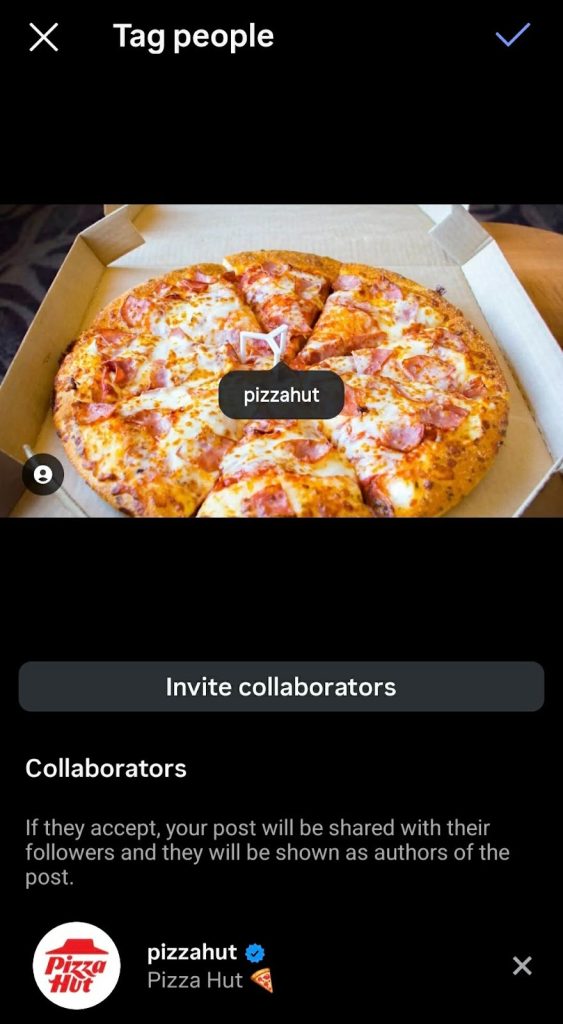
- Tap done, and publish!
- The accounts you added as collaborators will receive an invite. Once they accept the invite, the post will appear on both of your profiles.
Collaborating accounts can boost the post on their own. You don’t need to provide a spark code for ads like you do in TikTok.
Frequently Asked Questions
What’s the ideal account size to start pitching brands?
There’s NO ideal account size to start pitching.
As long as you have:
- A clearly defined niche
- A clearly defined audience (that matches your brand’s target customer)
- 6 – 12 brand-ready posts
- Decent engagement numbers (NOT follower count)
Then you’re ready to start pitching.
If you need a benchmark number anyway, try 1,000 followers.
How much engagement should I have before pitching to brands?
Aim for 4–10% engagement rate (likes + comments + shares ÷ followers).
But even if you don’t, as long as your posts get steady view numbers and are consistently getting comments, saves, and shares (instead of just likes), you’re still in a strong position to pitch to brands.
Should I niche down before pitching?
Yes, niching down increases your chances of landing a brand collab.
You can get collabs even if you’re in a broad niche. But brands prefer working with creators whose following matches their ideal customer profile.
How do I find the right brand contacts?
Check the brand’s Instagram bio for contact details. If there’s none, send them a DM asking who to contact about partnerships.
If they don’t reply, search LinkedIn and look for the PR or brand manager of the brand, and try connecting with them there.
Do I need a media kit before pitching?
Not necessarily, but having a professional media kit helps.
Again, as long as you can demonstrate that your audience matches their ideal customer profile, you have a very strong case for working together (even if you don’t have a professional media kit).
Can small creators really get paid collaborations?
Yes! I’ve worked with countless small creators who’ve landed paid collaborations.
Just follow the steps here carefully, and start pitching away.
Ready to Land Brand Collaborations?
Doing brand collabs is THE Instagram dream.
Not only do brands you love send you freebies to enjoy, but they actually PAY you while doing so.
So don’t wait.
Start researching the brands you want to work with today, follow the steps above carefully, and start building your account.
Want to build your account faster?
Then check out my guide on how to get more views on Instagram next!

Max Tornow
Founder, Smartphone Freedom Lifestyle
He’s helped thousands of creators across any niche and language turn content into views, followers, and income – with or without showing their face.
Over the past decade, Max has built multiple 7-figure brands, generated over $30M through content and social media, and coached creators worldwide to grow faster with proven systems, strategy, and human support.
→ About Max Tornow
→ About Smartphone Freedom Lifestyle
Some people think getting paid for brand collabs on Instagram goes like this:
- Create an Instagram account
- Post whatever you want
- People will start following you (somehow)
- Once you reach a certain number of followers (say, 10k followers), brands will suddenly start approaching you.
In reality, that rarely ever works.
If you want to get collabs, you need to be intentional about it.
Every successful creator gets their collabs not by luck or chance, but by creating an account that’s great for both followers AND brands alike.
How do you do this?
In this article, I’ll go over the 6 steps for success, so that you can get your first brand collab, get paid for it, and eventually turn your account into a thriving online business.
How to Get Collabs on Instagram
Step #1: Create an Account With Brands in Mind (Mindset Shift)
Most people who start an Instagram account think about what they want to post. Others think about what type of content will get followers.
But if you want brand collabs, you need to take it a step further.
Ask yourself:
“What type of content will make brands want to work with me?”
Start thinking like a brand, and ask:
- What kind of creator represents our ideal customer?
- Who can communicate our message well?
- Who already posts about topics related to our product category?
- Who has a style, tone, or personality that aligns with us?
You don’t have to do anything about it yet (we’re still on step 1!).
But this mindset shift puts you on the right track, and everything from here will make so much more sense.
Once you’re in, then proceed to the next step……
Step #2: Research Your Dream Brand
Start by making a list of 20-30 brands you’d love to work with.
Not just random brands, of course. Find brands that:
- Fit your planned niche
- Have products you’ll genuinely use
- Your target audience cares about (or should care about if it’s not a popular brand)
Make your list a mix of small, unknown brands, medium-sized brands, and even BIG brands (these are harder to reach, but you never know what can happen).
Once you have this list, research:
- Who their customers are
Their customers’ age, location, lifestyle, and hobbies.
The good news is that this is easy to figure out. Just take a look at how the brand advertises itself. If you pay attention to the type of people they feature in their ads, you’ll see who their target customer base is.
You can also head to the brand’s social media and take a peek at who follows them. Scroll through 50 or so followers, and you should see a pattern of what type of people follow the brand.
- What problems the brand is trying to solve when people buy the product
Again, study the brand’s advertising.
What pain points do they highlight for their target customers? How do they position their product as a solution to those pain points?
Also, check the brand’s reviews. Take note of what people love about the product, and pay attention to the negative reviews as well (this will tell you which promises were not delivered).
- The brand’s tone and personality (
Go to the brand’s social media pages and see what type of personality they use. Is it fun, serious, premium, minimalist, adventurous, or something else?
This is important because if the brands in your niche are more serious and “premium,” you might struggle to get a deal if your account is more playful.
- Which creators they currently work with
Finding creators that the brand already works with tells you that they’re open to brand collabs, and it also shows you what type of creators they work with.
Some ways to find the creators brands work with include checking the brand’s tagged photos in IG, searching the brand name in search, looking up hashtags like #brandname, or reverse searching by looking at a creator in your niche and checking who sponsors them.
You can use this information to build your Instagram account.
Make your niche target the brand’s ideal customer profile.
Talk about the pain points that the brand is trying to solve with its product.
Match the brand’s tone and personality.
And get content ideas from creators they already work with.
So many new creators skip this step when starting their account (and then wonder why getting brand collabs is “so hard”).
Some people get brand collabs without ever thinking about this step.
But the truth is, this small step before creating an account makes a HUGE difference in how easy scoring deals will be later on.
Step #3: Build Your Personal Brand
The next step is to build your personal account.
Your target audience is the same as the brand, but your tone should be uniquely you.
This is because people love following individuals.
If they sense that you’re a parrot for a brand, you’ll struggle getting loyal followers.
In the same note, brands love working with individuals, too.
They’re looking for individuals who their target customers look up to. That way, if you vouch for their brand, the people who look up to you will buy the product.
So… how do you build your account?
Here are some quick tips to get you up and running:
- Find Viral Ideas and Tweak Them — search for what’s going viral in your niche, copy the idea, but add your own unique twist!
- Post Every Day — without sacrificing quality. This not only gets you followers faster, but it also teaches you what works and what doesn’t in your niche very quickly.
- Use Keywords — use keywords related to your niche in your descriptions. Hashtags aren’t effective anymore, but Instagram categorizes your account by looking for keywords in your niche.
- Make an Original Series — an original series gives you unlimited content to post, and makes you noticeable to people in your niche.
- Answer Every Comment — interact with your community as much as possible. This helps build a loyal follower base.
- Show Your Face — while this is optional, showing your face brings so much authenticity to your account. This will be a huge help not only in getting followers but also scoring brand deals later on.
I go more in-depth into these in my How to Get More Followers post. So go check that out next.
But there’s one specific type of post you need to post if you want to work with brands — which brings us to our next step…
Step #4: Post Mutually Beneficial Reels
Don’t just post content that you or even your followers enjoy.
Mix in content that’s mutually beneficial for you AND the brands you want to work with too (even if you don’t have any deals yet).
If you have several posts that make your account “brand-ready,” it’ll be much easier to land a good deal. So here are some ideas you can try…
Lifestyle POVs
If your lifestyle matches that of the brand’s customers, then showcase your POV on things.
People will relate to you, and whatever problems you come across, so they’ll give you a follow.
And when brands see that you have an audience of their target customers, they’ll gladly pay you to promote their products.
Examples:
- “POV: Slow morning before work — coffee, skincare, and tidying.”
- “POV: Resetting my home after a long week.”
- “POV: Simple, peaceful Sunday routine.”
- “POV: Working from home while keeping life together.”
- “POV: Evening wind-down routine for stressed women.”
Problem-Solution
A variation of the lifestyle POV video where you talk about a common problem and how you fixed it.
This is great, especially if the problem is something the brand’s product can fix.
When you post reels like this, you can use your engagement numbers as leverage to strike a deal with a brand. Show them the numbers and say something like, “I could insert your product as the solution to all these people.”
Examples:
- “Struggling with clutter? Here’s how I reset my space in 10 minutes.”
- “If you’re always tired after work, try this simple routine.”
- “How I finally got consistent with skincare.”
- “What I do when I feel overwhelmed by my to-do list.”
- “The hack that helped me stop wasting money on groceries.”
Educational Tips
Educational tips establish you as an authority in the niche.
If your tips are super helpful and effective, people will naturally start looking to you whenever they run into problems.
This is a very strong position to have when working with brands because brands want someone their target customers already trust.
Examples:
- “3 skincare mistakes women in their 30s still make.”
- “How to build outfits with basic pieces you already own.”
- “Easy home habits that reduce stress.”
- “How to meal prep when you’re busy (but hate meal prep).”
- “Ways to make your home feel calmer instantly.”
Opinion Content
Post opinion pieces that align with the brand’s values.
For more “premium” brands, talk about why quality matters more than quantity. For more budget brands, talk more about value.
Examples:
- “Why your 30s are the best time to reinvent yourself.”
- “Why quality basics beat trendy fast fashion.”
- “Why ‘doing less’ is actually more productive.”
- “Why taking care of your home is self-care.”
- “Why skincare matters more than makeup as you get older.”
Before/After Transformations
This works particularly well in the beauty industry, where you show before/after makeup, hair, etc. But it can also work great in any niche.
Show what things were like before, what you did, and the amazing results afterward.
If you master this format, it becomes very easy to make the brand’s product the thing that caused the transformation.
Examples:
- “Before/after organizing my bathroom counter.”
- “Before/after my weekly fridge reset.”
- “Before/after cleaning my makeup drawer.”
- “Before/after switching from full glam to minimalist makeup.”
- “Before/after decluttering one small corner of my house.”
Product Reviews
Do product reviews of things that you already use, even if you aren’t sponsored.
This prepares your audience for branded content (so they won’t be annoyed when suddenly you start posting sponsored reels), and it also shows brands how you can highlight their product.
Good product reviews take skill, so get some practice by doing non-sponsored posts first.
Examples:
- “My honest review of the moisturizer that saved my skin.”
- “Trying the $15 leggings everyone keeps talking about.”
- “Reviewing my favorite under-$25 kitchen tools.”
- “The planner that finally helped me stay consistent.”
- “My go-to everyday makeup products for a natural look.”
All these content ideas are ripe for inserting a sponsor.
Having these ready will help you a LOT when it comes to the next step…
Step #5: Pitch To Brands
I know what you’re thinking…
“How many followers do I need to start pitching to brands?”
There’s no magical number that unlocks brand deals for you. Sure, having 100,000 followers helps, but some accounts have gotten brand deals with fewer than 1k followers.
The trick is to show proof of influence.
If you have a clear, well-defined niche, you have 6 – 12 reels that are brand-ready, and you have engagement stats to show that people interact with you, then you’re ready to start pitching.
You can start with smaller and medium-sized brands first.
Smaller brands will probably be interested, but they might not have the budget for paid collabs. Normally, I don’t suggest taking freebies without payment, but if it’s your first time and you just want the experience, then go for it.
Smaller brands also might not have any experience working with creators yet, so you may have to work out a deal together.
Medium-sized brands are the sweet spot for new creators. These brands usually already have a process; they have terms ready, and striking a deal is relatively easy. Most of all, they already have a budget for creator marketing, so all you have to do is convince them why they should use it on you.
Big brands will require a bigger following to work with. You might also need to showcase other brands you’ve worked with to show them you’re not a waste of their time.
But you can still pitch to them right away, just to try. And who knows? They might just tell you what their standards for collaboration (ex, minimum 10k followers) are.
So, find the contact details of the brand you want to work with, and send them a dm or an email.
Here’s a simple pitch template that you can use (make sure to personalize it as much as possible):
Hi [Brand Name / Contact Person],
My name is [Your Name] and I’m a creator who makes [your niche] content for [their target audience].
I’d love to help you get in front of more of your ideal customers — specifically [describe their target customer] who are already a big part of my audience. I have a total audience size of [X] and my content consistently reaches people who are actively interested in [problem the brand solves / product category].
I’d love to create content for you — whether that’s UGC, Reels, or posts for your social channels.
Here are a few examples of my brand-aligned content:
[Link 1]
[Link 2]
[Link to your portfolio or Instagram]
If you’re currently working with creators, I’d be excited to discuss how we can collaborate.
Thanks so much for your time!
[Your Name]
[Your Instagram handle / portfolio]
If your dream brand responds well, congratulations!
Your hard work has paid off. Now all that’s left to do is negotiate your rates.
If they don’t respond or respond negatively, don’t fret. Instead, do this next step.
Step #6: Follow Up
If all your pitch gets are crickets, send up a gentle follow-up message 5-7 days after your first pitch.
Something short and simple like this (tweak this message to your tone):
Hey there,
Just wanted to circle back. I’m sure you’re super busy–just wanted to make sure this didn’t fall through the cracks.
Again, tweak these messages to match your personal tone.
If your dream brand doesn’t want to work with you, it’s not the end of the world.
Chances are, there are other brands in the niche who value your work and would LOVE to work with you (and pay you more than you expect).
The great thing about intentionally building up your account for brand deals is that even if you can’t strike a deal with your dream brand, it won’t be difficult to get other brand deals.
Your profile is so optimized for a partnership, companies won’t want to miss out on an opportunity to market their product to a highly-engaged audience.
So keep working.
Pitch to other brands.
And you’ll strike your first deal before long.
How to Use Instagram’s Collab Post Feature
Now that you’ve struck a deal, how do you actually use Instagram’s collab post feature?
Here’s a quick tutorial:
- Open Instagram, click on create, upload your post/reel/carousel.
- On the last page, right before publishing, click on “Tag People” and tap “Invite collaborators.”
- Search for the username of the account you want to collab with (you can collab with several accounts at a time)
- Tap done, and publish!
- The accounts you added as collaborators will receive an invite. Once they accept the invite, the post will appear on both of your profiles.
Collaborating accounts can boost the post on their own. You don’t need to provide a spark code for ads like you do in TikTok.
Frequently Asked Questions
What’s the ideal account size to start pitching brands?
There’s NO ideal account size to start pitching.
As long as you have:
- A clearly defined niche
- A clearly defined audience (that matches your brand’s target customer)
- 6 – 12 brand-ready posts
- Decent engagement numbers (NOT follower count)
Then you’re ready to start pitching.
If you need a benchmark number anyway, try 1,000 followers.
How much engagement should I have before pitching to brands?
Aim for 4–10% engagement rate (likes + comments + shares ÷ followers).
But even if you don’t, as long as your posts get steady view numbers and are consistently getting comments, saves, and shares (instead of just likes), you’re still in a strong position to pitch to brands.
Should I niche down before pitching?
Yes, niching down increases your chances of landing a brand collab.
You can get collabs even if you’re in a broad niche. But brands prefer working with creators whose following matches their ideal customer profile.
How do I find the right brand contacts?
Check the brand’s Instagram bio for contact details. If there’s none, send them a DM asking who to contact about partnerships.
If they don’t reply, search LinkedIn and look for the PR or brand manager of the brand, and try connecting with them there.
Do I need a media kit before pitching?
Not necessarily, but having a professional media kit helps.
Again, as long as you can demonstrate that your audience matches their ideal customer profile, you have a very strong case for working together (even if you don’t have a professional media kit).
Can small creators really get paid collaborations?
Yes! I’ve worked with countless small creators who’ve landed paid collaborations.
Just follow the steps here carefully, and start pitching away.
Ready to Land Brand Collaborations?
Doing brand collabs is THE Instagram dream.
Not only do brands you love send you freebies to enjoy, but they actually PAY you while doing so.
So don’t wait.
Start researching the brands you want to work with today, follow the steps above carefully, and start building your account.
Want to build your account faster?
Then check out my guide on how to get more views on Instagram next!
Max Tornow
Founder, Smartphone Freedom Lifestyle
He’s helped thousands of creators across any niche and language turn content into views, followers, and income – with or without showing their face.
Over the past decade, Max has built multiple 7-figure brands, generated over $30M through content and social media, and coached creators worldwide to grow faster with proven systems, strategy, and human support.
→ About Max Tornow
→ About Smartphone Freedom Lifestyle
Limited Offer
Feel Like Your Content’s
Invisible Online?
1-on-1 coaching. Personalized Content Strategies & Viral Techniques & Templates designed for today’s algorithm.
Join 2,000+ content creators proving it’s never too late to breakthrough online.